
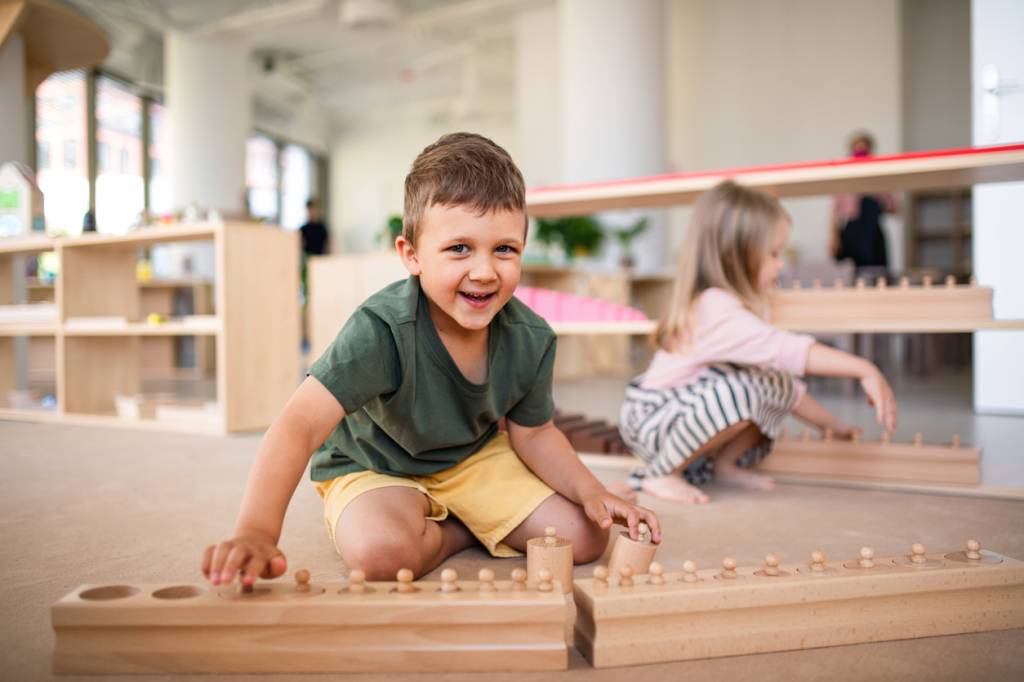
This guide covers the main categories of Montessori material suppliers, from professional classroom manufacturers to Etsy sellers to major retailers, and gives practical guidance on how to evaluate what you are looking at, what to prioritize, and how to avoid the most common and expensive purchasing mistakes.
Before you buy anything: the most important question
Before purchasing any Montessori material, ask yourself: what developmental purpose does this serve, and is my child at the developmental stage where they can use it? Many families spend significant money on materials that are presented too early (before the child is ready), too late (after the sensitive period has passed), or without adequate adult understanding of how to introduce them. An authentic Nienhuis Pink Tower on a shelf where no one uses it is less valuable than a set of graduated containers used well every day.
Purchasing decisions should be guided by your child's current developmental stage and your ability to present the material correctly, not by the desire to assemble a complete Montessori environment all at once. Start with the highest-impact materials for your child's current age, learn to use them well, and add others gradually.
The three tiers of Montessori material quality
Tier 1: Professional classroom manufacturers
These are the manufacturers whose materials are used in AMI- and AMS-accredited schools. Their materials are made to the exact specifications required by each material's educational function, precise measurements, correct materials, appropriate weight and texture. They are the most expensive and the most durable.
- Nienhuis Montessori (Netherlands, ships internationally), the oldest and most widely used professional Montessori manufacturer. AMI-approved. Materials are made to exacting standards and backed by decades of classroom use. Expensive, but the definition of authentic.
- Gonzagarredi Montessori (Italy), another AMI-approved manufacturer with a long professional history. Materials comparable in quality to Nienhuis, sometimes at slightly different price points.
- Albanesi Montessori: Italian manufacturer, similarly professional quality.
For home educators: Tier 1 materials make sense for the materials whose precise design is most critical to their function, the Golden Bead material, the full Sandpaper Letter set, the Pink Tower. For other materials, Tier 2 is often perfectly adequate.
Tier 2: Quality home and school suppliers
These suppliers make materials specifically for the Montessori market but at lower price points than Tier 1. Quality varies more widely in this tier, some items are excellent, others are noticeably lower quality. Research specific items rather than buying all materials from a single supplier in this category.
- Montessori Outlet: US-based, wide selection, reasonable prices. Quality is good for many materials, inconsistent for some. Check recent reviews before purchasing any specific item.
- Kid Advance: another US-based option with broad selection. Similar quality profile to Montessori Outlet.
- Adena Montessori: Chinese manufacturer, widely available on Amazon. Lower price point, generally acceptable quality for home use, not professional classroom quality.
- Michael Olaf Montessori: a curated selection of infant and toddler materials with strong focus on the 0-to-3 curriculum. Good for the early years.
Tier 3: Handmade, Etsy, and DIY
A significant market of Montessori-aligned handmade materials exists on Etsy and similar platforms. These range from beautifully crafted wooden materials made by skilled woodworkers to printed card materials (three-part cards, classified cards, nomenclature cards) that are often indistinguishable in educational value from commercially printed versions.
Etsy is particularly strong for:
- Printed language materials (three-part cards, phonogram materials, grammar cards), often high quality and much less expensive than commercial equivalents
- Handmade Movable Alphabet boxes, where an Etsy seller who makes Montessori materials full-time can produce something excellent at a fraction of the Nienhuis price
- DIY-friendly sets (Sandpaper Letter templates, Gobbi mobile kits, dressing frame patterns)
What to buy first: a priority guide by age
For an infant (birth to 12 months)
The highest-value purchases for this stage are the four infant mobiles. These can be purchased as a set from Tier 2 suppliers (expect $40 to $100 for all four) or made at home (all four can be DIY'd for under $30 in materials, and detailed guides are widely available). Add a solid wooden grasping ring, a bell cylinder, and an object permanence box. This is the complete infant Montessori environment. Nothing else is necessary.
For a toddler (1 to 3 years)
Priority purchases: knob puzzles (three to five, in graduated complexity), a spooning/pouring transfer tray, child-sized practical life tools (broom, dustpan, watering can), and the first dressing frames (large button and snap). A wooden nesting set for visual discrimination. A basket of real objects for language development. Total cost, sourced thoughtfully: under $200.
For primary age (3 to 6 years)
This is where the core Montessori language and math materials come in. Priority order:
- Sandpaper Letters, can be DIY'd effectively; commercial versions run $80 to $120
- Movable Alphabet, DIY with index cards is workable; a good commercial version runs $60 to $100
- Number rods or equivalent, DIY with tape-marked dowels is reasonable
- Golden Beads, this one benefits from quality; budget $80 to $150 for a home set
- Pink Tower, expensive for authentic quality; consider Tier 2 at $60 to $100
For elementary age (6 to 12 years)
At this age, the most important "materials" shift toward books, research tools, and real equipment for real projects. The Montessori math materials that are most valuable at home: the checkerboard for multi-digit multiplication (available from Tier 2 suppliers at $40 to $80) and the fraction circles (similarly priced). Otherwise, invest in quality nonfiction reference books, a good globe, and real tools.
Evaluating materials before you buy
Before purchasing any material, from any source, ask these questions:
- Is this material designed for my child's current developmental stage, not six months ahead?
- What single quality or concept does it isolate?
- What is the control of error? How does the material tell the child when they've made a mistake?
- What does it feel like? Wood, metal, and natural materials feel fundamentally different from plastic, in ways that matter to sensory development.
- Is there a DIY version that would work equally well? If the answer is yes, make it, the money saved can go toward materials where quality genuinely matters.
Secondhand Montessori materials
Authentic Montessori materials, particularly professional Tier 1 materials, are extremely durable. A well-maintained Pink Tower from Nienhuis will outlast decades of use. The secondhand market for these materials is active: school closures, classroom upgrades, and families whose children have aged out of materials all generate quality secondhand inventory.
eBay and Facebook Marketplace are the most productive sources for secondhand Montessori classroom materials. When buying secondhand, verify that all components are present (a Sandpaper Letter set missing three letters is significantly less useful) and that wood is not split, warped, or painted over. Metal components should operate smoothly. Fabric components should be intact and cleanable.
The real cost is time, not money
A home that spends $2,000 on Montessori materials and never learns to present them well will see less benefit than a home that spends $200 and takes the time to understand how each material works, when to introduce it, and how to step back and let the child do the work. The most important investment you can make in Montessori education at home is not in materials, it is in understanding the principles that make those materials work. Reading thoroughly, observing your child carefully, and learning to present slowly and without narration will produce more developmental benefit than any catalog purchase.