
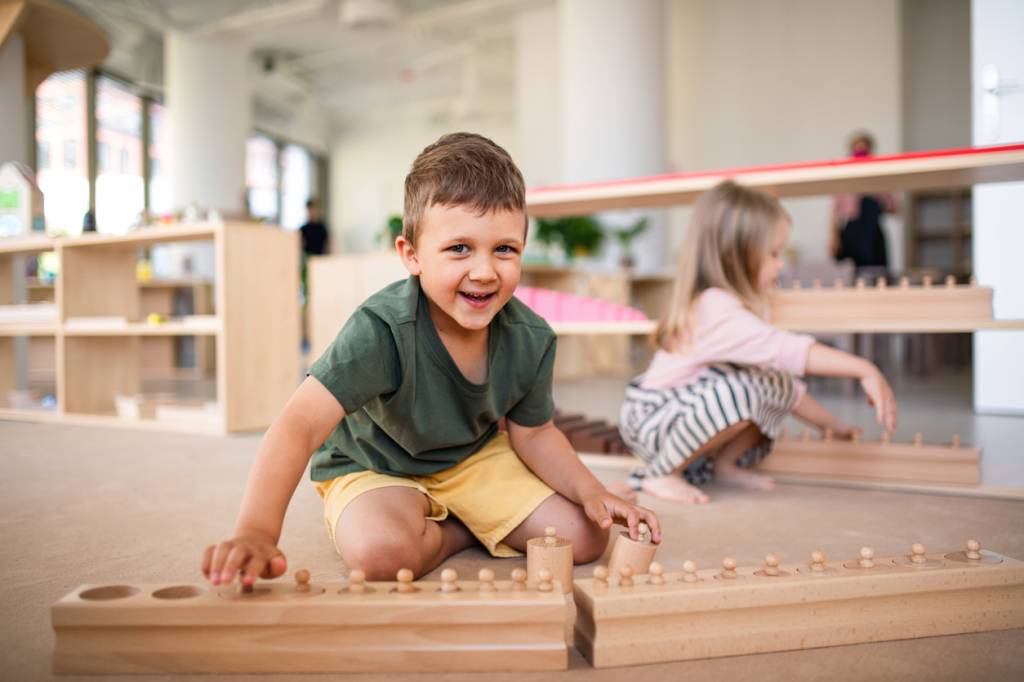
Between the ages of three and six, children are in the second half of the Absorbent Mind period, moving from unconscious to conscious absorption. The primary classroom is designed to meet this shift: an environment rich enough in possibility that the child's developing consciousness has real, meaningful work to turn toward.
The five curriculum areas
The Montessori primary curriculum is organized into five interconnected areas, each with its own section of the classroom and its own developmental progression of materials.
Practical Life
Every Montessori primary classroom begins with practical life, the category of activities that develops coordination, concentration, independence, and care for the environment through real, purposeful household tasks. Pouring, spooning, threading, folding, polishing, plant care, food preparation, and personal care (dressing frames, shoe care, hand washing) all fall here.
Practical life is not a warm-up for "real" learning. It is foundational to everything that follows. The concentration developed by carefully pouring dry rice from one container to another is the same concentration applied to tracing Sandpaper Letters ten minutes later. The fine motor control developed by using a small baster to transfer water is the same control used to hold a pencil at age five. Practical life builds the capacities on which all academic learning depends.
Sensorial
The sensorial curriculum uses carefully designed materials to help children develop precise, discriminating perception across all the senses. The Pink Tower (dimension), the Brown Stair (dimension and width), the Color Tablets (hue), the Sound Boxes (auditory discrimination), the Baric Tablets (weight), the Geometric Solids (shape), the Thermic Tablets (temperature), each material isolates one quality and invites the child to sort, seriate, match, or grade it.
This is not a training program in perception. It is the development of the sensory vocabulary and precision that will later support mathematics, geometry, music, and science. A child who has spent months discriminating the ten shades of the Color Tablets has built a neural precision for color distinction that will serve them in ways no explicit lesson on "red, blue, yellow" could replicate.
Language
Language arts in the Montessori primary classroom begins with spoken language, vocabulary enrichment, storytelling, classification games, and the three-period lesson applied to naming. Writing comes before reading in the Montessori sequence, because tracing letter shapes with the body (through the Sandpaper Letters) prepares the hand for writing before the eye is ready to read.
From the Sandpaper Letters, children move to the Movable Alphabet, a set of loose letters used to compose words by ear, without needing to physically write. Many children in Montessori primary classrooms "write" their first words using the Movable Alphabet months before their fine motor control allows them to hold a pencil confidently. Reading emerges afterward, as a consequence of the rich phonemic awareness built through the language sequence.
It is common for children in well-run Montessori primary classrooms to read spontaneously, to achieve an "explosion into reading", between ages four and five. This is not the result of drilling. It is the natural outcome of a sequence of materials that builds phonemic awareness, letter-sound correspondence, and word composition systematically over months.
Mathematics
Montessori math begins with concrete manipulation of quantity and progresses, over the three primary years, toward increasingly abstract representations. The Golden Bead material introduces the decimal system through physical objects, single beads (units), bars of ten, squares of 100, and cubes of 1000. Children handle, count, and exchange these materials for years before they are asked to represent the same concepts symbolically.
The result is children who understand what place value means, not as an abstract convention, but as a concrete reality they have held in their hands. When a Montessori child writes "3,142," they have a tactile, visual, and spatial understanding of what that number represents that typically developing children in conventional schools often lack.
Cultural studies
The fifth area of the primary curriculum encompasses geography, biology, zoology, botany, music, art, and history. Children work with puzzle maps of the continents and countries, classification cards for animals and plants, materials for exploring the four kingdoms of nature, and simple timelines connecting the child's life to human history. This is not a unit-study curriculum, it is a continuous, immersive encounter with the world that deepens as the child's capacity for abstraction grows.
The daily rhythm
The primary classroom operates on what Montessori called the "work cycle", typically a three-hour uninterrupted morning block during which children choose their work, execute it, and return it, before choosing again. Research consistently shows that this uninterrupted period is essential for the development of deep concentration. Frequent transitions and short activity blocks undermine exactly the focused engagement that Montessori is designed to produce.
There are no bells. No group transitions from subject to subject. The guide circulates, observes, and offers individual lessons, generally a five-to-ten-minute presentation of a new material, followed by stepping back to let the child work.