
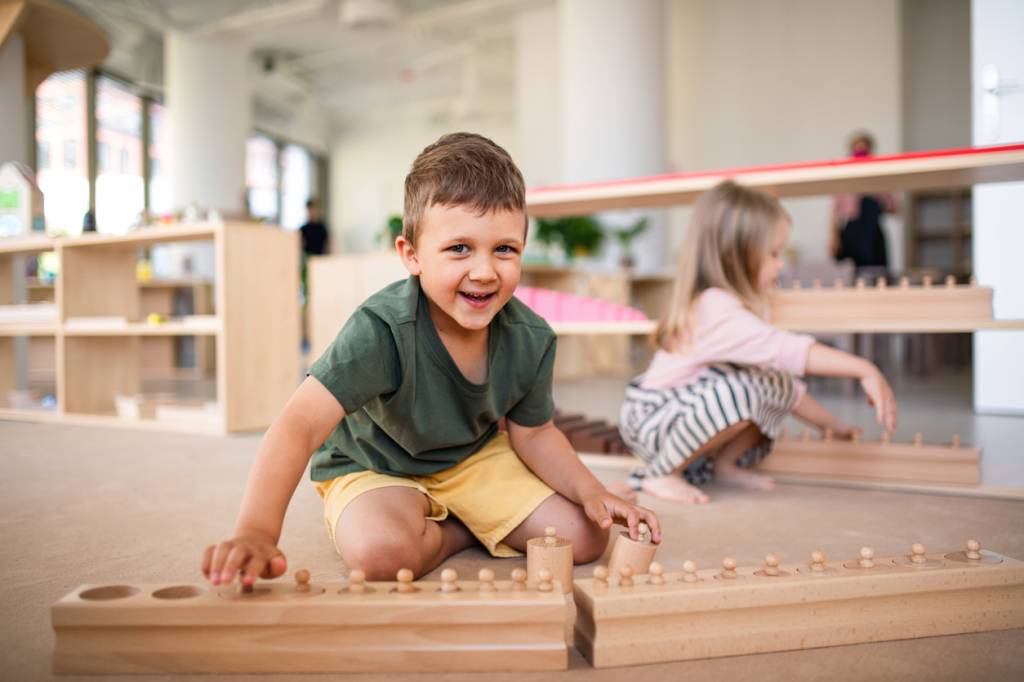
When you walk into a well-prepared Montessori classroom, what you notice first is usually the materials: beautiful wooden objects arranged on low shelves, each one in its own designated place. But the beauty is not decorative. Every aspect of the materials, their weight, texture, color, shape, and sequence of presentation, reflects a theory of how children learn, refined through decades of observation and research. Understanding what makes Montessori materials different explains much of why the method works.
What makes a material "Montessori"
Not every wooden toy is a Montessori material. Not every "educational" product marketed to parents meets the criteria. Genuine Montessori materials share four defining characteristics:
1. Isolation of one quality
Every authentic Montessori material varies along only one dimension while keeping all other variables constant. The Pink Tower's ten cubes are all the same pink, the same texture, the same material, only their size differs. This deliberate isolation ensures that the child's attention focuses on precisely the quality being explored, without competing variables pulling focus. It is the same principle that makes a well-designed scientific experiment valid: when one thing varies and everything else stays constant, you can know what you are learning.
2. Control of error
Montessori materials are designed to tell the child when they have made a mistake, without the teacher's involvement. This is called control of error. When the Pink Tower is built incorrectly, it looks wrong and may topple, the material gives immediate visual feedback. When the Cylinder Blocks are assembled incorrectly, the remaining cylinders won't fit in the remaining holes, the material physically prevents the error from being completed without correction. This feature is essential because it allows the child to work independently, to identify and correct their own mistakes, and to develop the internal monitor that is the foundation of real self-discipline.
3. Aesthetic beauty and real materials
Montessori materials are made of real materials, wood, glass, metal, natural fabric, and they are beautiful. This is not an indulgence. It is a deliberate choice: children are more drawn to, more careful with, and more respectful of beautiful things. A child who handles a wooden cylinder with care is developing the attentiveness and physical discipline that will transfer to every subsequent task. A child who handles a plastic toy with less care is practicing a different relationship to objects and to work.
4. Developmental sequence
No Montessori material exists in isolation. Each one is part of a carefully designed sequence that moves from concrete to abstract, from simple to complex, from sensory experience to conceptual understanding. The Pink Tower, the Brown Stair, and the Red Rods are not three separate materials, they are three stages in a sequence that builds the child's understanding of three-dimensional dimension before any mathematical vocabulary is introduced. Understanding the sequence matters as much as understanding the individual material.
Browse materials by area
Which materials actually matter
A full Montessori classroom contains several hundred materials. A home environment does not need, and could not accommodate, all of them. The question for most families is: which ones provide the most developmental value relative to cost, space, and the specific needs of their child?
The honest answer is that the most important materials in a primary Montessori environment are also among the most reproducible at home or the most available secondhand. The Sandpaper Letters can be made from sandpaper and card stock. The Movable Alphabet can be made from index cards in two colors. The Pink Tower is expensive to buy and difficult to DIY authentically, but its developmental purpose (visual discrimination of dimension) can be approximated with graduated containers or commercially available nesting sets of the right design.
The materials that are most worth investing in for home use are those whose precise design is most important to their function, the Golden Beads, for example, where the exact quantity (100 individual beads in a bar of 10) is inseparable from the concept being taught. A substitute that approximates the look but not the quantity does not teach the same thing.
Authentic vs. "Montessori-inspired"
The word "Montessori" is not trademarked, and any manufacturer can use it on any product. This means that the marketplace is full of products labeled "Montessori" that share only a superficial resemblance to the genuine materials, toy wooden kitchens labeled as "Montessori practical life," wooden shape sorters with no relationship to the actual Montessori geometry curriculum, activity kits called "Montessori at home" that violate every design principle Montessori established.
This is not a trivial concern. A material that looks Montessori but does not isolate a quality, does not have control of error, and is not part of a coherent sequence does not produce the same developmental outcomes as a genuine material. It may be a fine toy. It is not a Montessori material.
The best way to evaluate any material is to ask: what single quality does this isolate? What is the control of error? What comes before and after it in the sequence? If those questions don't have clear answers, the material is probably not authentically Montessori, whatever its label says.
The most important material is not an object
After more than a century of use, Montessori practitioners consistently make the same observation: the most important "material" in a Montessori environment is the prepared adult. A beautifully equipped classroom in which the guide observes poorly, presents carelessly, and intervenes constantly produces worse outcomes than a modest environment in which the adult understands the child's development deeply and trusts the process. The materials matter. The adult who knows how to use them matters more.