
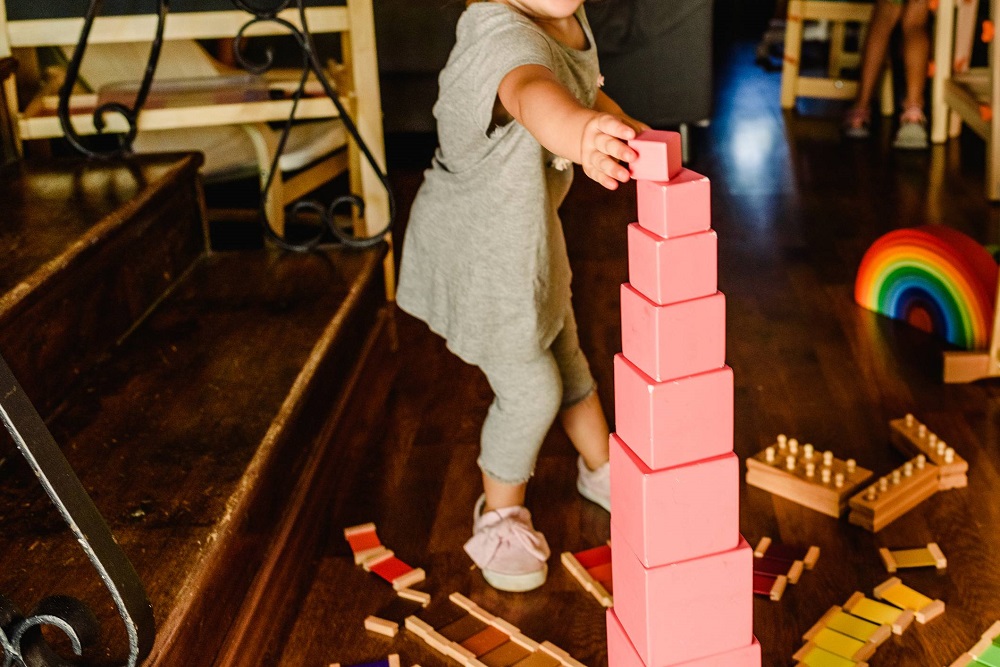
The three-to-six window is when the classic Montessori activities most people recognize become possible and appropriate. The Pink Tower, the Sandpaper Letters, the Golden Beads, these are all primary materials, designed for this age range. But many of the most effective Montessori activities for this age cost nothing and require no special materials at all.
Sensorial activities
The sensorial curriculum peaks in the primary years. Children are developmentally ready to work with materials that isolate individual qualities for discrimination and categorization.
- The Pink Tower: ten wooden cubes in graduated sizes, stacked from largest to smallest. Teaches visual discrimination of three-dimensional dimension and introduces the mathematical concept of the cube.
- Sound shakers: pairs of small containers filled with different materials (rice, sand, beans, bells). Match by sound. An excellent ear-training activity that also develops the working memory needed to hold one sound in mind while testing others.
- Fabric matching: pairs of fabric squares in different textures (silk, velvet, cotton, burlap). Match by feel, first with eyes open, then blindfolded.
- Nature collections: sort by weight, texture, color, or smell. Natural materials are richer for sensory work than manufactured ones.
Language activities
- Sandpaper Letters: trace with two fingers, say the phonetic sound (not the letter name). The tactile experience of the letter shape plus the auditory experience of the sound builds the association that will eventually support both reading and writing.
- Sound identification games: "I spy something that starts with /sss/." Phonemic awareness games that require no materials and can happen anywhere.
- Object classification: small baskets with miniature objects sorted by initial sound, final sound, or number of syllables
- Movable Alphabet: loose letters used to compose words phonetically. A child who cannot yet write can compose full sentences using the Movable Alphabet.
Math activities
- Number rods with numerals: a classic Montessori material that associates a physical quantity (the length of the rod) with its numeral symbol
- Bead work: counting beads on a string, building bead bars for each digit 1–9, and eventually constructing the bead chains for skip counting
- Simple addition with objects: "Here are 3 red cubes and 2 blue ones. How many cubes altogether?" Concrete always before abstract.
- Geometric puzzle maps: wooden or cardboard puzzle maps of the continents and individual countries. Geography and spatial reasoning together.
Practical life at this age
By age four, practical life activities can include genuine food preparation: cutting soft fruits with a child-safe knife, grating cheese with a box grater, cracking eggs into a bowl. These are not demonstrations, the child makes real food that the family eats. The competence and pride this produces is qualitatively different from anything a craft activity can provide.
Other practical life for this age: polishing shoes, folding fitted sheets (surprisingly difficult and satisfying), setting a complete formal table, sewing a simple seam by hand.
Art activities
Montessori art at this age is process-oriented, not product-oriented. The goal is not a cute project to send home, it is the experience of using real materials skillfully.
- Watercolor painting with real brushes on heavyweight paper, learning to rinse the brush between colors
- Drawing from observation, placing an object (a flower, a shoe, a piece of fruit) on the table and drawing it carefully
- Weaving on a small cardboard loom, excellent for fine motor development and pattern recognition
- Clay modeling with real clay, not playdough, real clay requires more force, develops hand strength differently, and produces a lasting object