
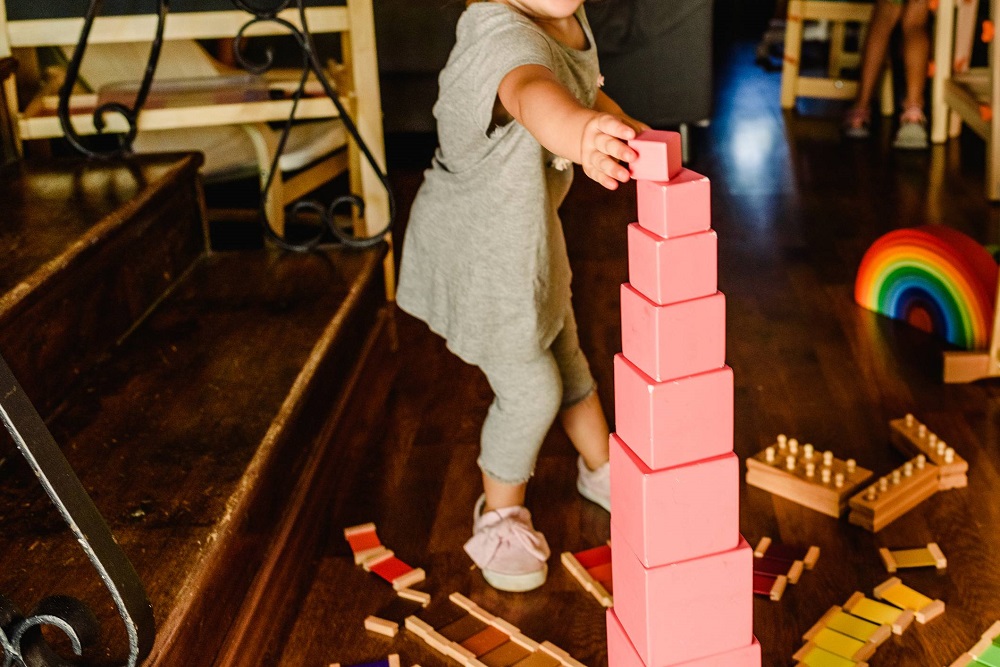
In Montessori education, the sensorial curriculum serves as the bridge between practical life (which develops concentration and coordination) and academic work (which requires abstract thought). By systematically developing the child's sensory perception, their ability to discriminate, categorize, and describe the qualities of the physical world, the sensorial materials build the cognitive vocabulary that mathematics, geometry, music, and science will later draw on.
The principle of isolation of quality
Every Montessori sensorial material is designed around one core principle: isolation of quality. This means that each material varies along only one dimension, while all other variables are controlled. The Pink Tower's ten cubes are all the same pink, the same texture, and the same material, only their size differs. The Sound Boxes all look identical, only their contents differ. The Baric Tablets all look identical, only their weight differs.
This deliberate design ensures that the child's attention is focused precisely on the quality being explored, without competing variables pulling focus. The child learns, through direct physical experience, to perceive differences they would otherwise overlook, and this precision of perception will serve them in every domain that follows.
The sensorial materials: a survey
Visual discrimination
- Pink Tower: ten wooden cubes in sizes from 1 cm to 10 cm, stacked from large to small. Teaches three-dimensional dimension and the mathematical concept of the cube.
- Brown Stair: ten wooden prisms varying in two dimensions (width and height). Teaches the concept of thickness and introduces the mathematical prism.
- Color Tablets: three boxes of colored tablets. Box 1 isolates primary colors; Box 2 expands to eleven colors; Box 3 presents eight shades of each color for grading. Develops color discrimination and vocabulary.
- Geometric Cabinet: 35 wooden shapes in six different drawers (circles, rectangles, triangles, polygons, curvilinear figures, and others). Develops visual discrimination of two-dimensional form.
- Geometric Solids: ten solid wooden geometric forms (sphere, cylinder, cube, rectangular prism, pyramid, cone, and others). Introduces the vocabulary and physical sense of three-dimensional geometry.
Tactile discrimination
- Touch Boards: alternating strips of smooth and rough sandpaper. Introduces the vocabulary of rough and smooth through direct experience.
- Touch Tablets: grades of sandpaper from finest to coarsest. Develops discrimination of texture degree.
- Fabric Boxes: matching pairs of fabric swatches in different textures, silk, velvet, cotton, linen, burlap. Matched first with eyes open, then with a blindfold.
Auditory discrimination
- Sound Boxes: two sets of six matching cylinders containing different materials (sand, rice, beans, etc.). Matched by sound, first with eyes open, then blindfolded.
- Bells: a set of bells in the diatonic scale, matched by tone and eventually graded from lowest to highest.
Baric and thermic discrimination
- Baric Tablets: three sets of tablets in wood, of the same size but different densities (and therefore weights). Graded from lightest to heaviest, first with eyes open, then blindfolded.
- Thermic Tablets: pairs of tablets in materials that conduct heat differently (wood, cork, glass, metal, felt). Matched by temperature sensation through touch.
Stereognostic sense
The stereognostic sense, the ability to identify objects by touch alone, is developed through activities that require the child to reach into a bag or box and identify objects without seeing them. Mystery bags filled with familiar objects, the Geometric Solids with eyes closed, and the Cylinder Blocks removed and replaced without visual guidance all develop this capacity.
Sensorial activities without classroom materials
While the classic materials are beautifully designed, many sensorial activities can be approximated at home:
- Nature texture walk: collect objects of different textures from outside (smooth stone, rough bark, soft moss, dry leaf) and sort or grade by texture
- Mystery bags: place familiar household objects in a pillowcase and identify by touch alone
- Sound shakers: small matching containers (empty film canisters or similar) filled with different materials, rice, beans, sand, bells. Make two of each and match by sound.
- Kitchen smelling: small jars with different spices, herbs, or extracts under cloth covers. Identify and match by smell.